
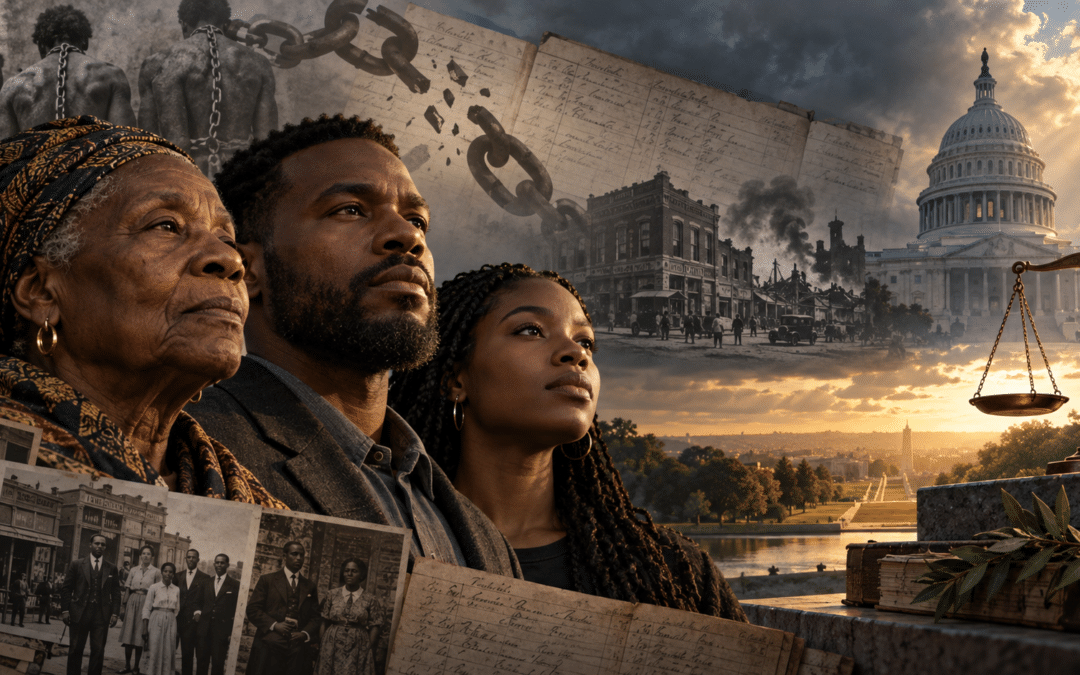
From slavery to Black Wall Street, from broken promises to generations of government studies, America’s unpaid debt to Black Americans is not a mystery. It is a matter of political will.
America knows how to pay reparations. It has demonstrated that ability repeatedly. The federal government has compensated Japanese Americans for wartime incarceration, authorized payments to survivors of the Japanese occupation of Guam, settled historic claims involving Native American tribes, and funded services for Holocaust survivors living in the United States.
Yet when Black Americans descended from people enslaved in this country demand compensation for centuries of stolen labor, stolen land, destroyed wealth, legalized discrimination, and government-sanctioned violence, the conversation suddenly becomes complicated.
We are told that too much time has passed, that the original victims are dead, that determining eligibility is too difficult, that the cost would be excessive, or that another study is necessary.
These objections deserve scrutiny because America has already demonstrated that historical injuries can be documented, descendants can be identified, compensation can be calculated, and government funds can be distributed.
The central question is no longer whether America knows how to make reparations. It is why the nation has repeatedly declined to establish a comprehensive federal reparations program for Black Americans.
The Debt Did Not End When Slavery Ended
The case for reparations is frequently reduced to the unpaid labor of enslaved Africans and their descendants. That injustice alone warrants serious consideration. But the actual debt extends far beyond 1865.
Enslaved Black Americans were denied the wages, property ownership, inheritance, education, family stability, and legal protections necessary to accumulate and transfer wealth. Their labor helped build the agricultural, commercial, and financial foundations of the United States, enriching plantation owners, banks, insurers, manufacturers, and other institutions.
When emancipation arrived, most formerly enslaved people received neither compensation for their labor nor meaningful economic assets to begin independent lives. The promise associated with forty acres and a mule was largely reversed, leaving generations of formerly enslaved families without the productive land necessary to establish lasting economic security.
The injustice continued through Black Codes, convict leasing, Jim Crow segregation, racial terrorism, discriminatory government programs, housing restrictions, exclusionary lending, and the destruction of prosperous Black communities.
The federal government did not merely tolerate every aspect of this system. At different points, it actively created, administered, enforced, or protected discriminatory laws and practices.
In 1862, for example, the federal government compensated certain enslavers in Washington, D.C., for the emancipation of people they had legally claimed as property. The people who had endured enslavement received no equivalent payment.
Consider the moral contradiction: The government compensated people for losing ownership of other human beings while failing to compensate the human beings whose freedom, labor, and lives had been stolen.
That history is also documented in the 2023 reparations resolution introduced by Representative Cori Bush, which details federal involvement in enslavement, racial dispossession, discriminatory economic policy, and the continuing effects of those injustices. The resolution calls for financial compensation alongside institutional reform, restitution, and healing. It was a proposal, not an enacted reparations program.
From Here to Equality: The Economic Case Is Already Documented
In their landmark book From Here to Equality: Reparations for Black Americans in the Twenty-First Century, economist William A. Darity Jr. and researcher A. Kirsten Mullen provide one of the most comprehensive modern arguments for Black American reparations.
Their work identifies three broad periods of injustice: slavery, the century of Jim Crow oppression that followed, and continued discrimination and racial inequality in modern America.
Darity and Mullen argue that the appropriate federal reparations program should prioritize Black Americans who can establish ancestral ties to people enslaved in the United States, using defined ancestry and identity criteria. They also emphasize direct financial compensation rather than substituting ordinary social programs for the repayment of a specific historic debt.
Their approach is especially important because it makes reparations measurable. It connects historic dispossession with the accumulated loss of wealth that families might otherwise have passed from one generation to another.
The Federal Reserve’s household wealth research independently documents the persistence of large racial wealth disparities. Such disparities are not, by themselves, proof that every dollar of the gap results from slavery. However, combined with extensive historical records of discrimination and dispossession, they help demonstrate why freedom under the law has not necessarily produced economic equality.
Representative Bush’s 2023 resolution cited an estimated $14 trillion as a minimum amount necessary to address the Black-white wealth gap. That figure is a proposed benchmark based on economic scholarship, not an amount adopted or approved by Congress.
America Wasn’t Alone: Britain Compensated the Enslavers, Not the Enslaved
Reparations are not a request for charity, and they are not simply another antipoverty program. They are a demand that identified injuries, responsible institutions, and measurable losses be addressed through a formal process of restitution and repair.
In 1833, when Britain abolished slavery throughout most of its empire, the British government allocated £20 million, approximately 40% of its annual expenditure, to compensate enslavers for the loss of their so-called property. The more than 800,000 enslaved Africans who were being emancipated received nothing. Instead, British taxpayers financed compensation for those who had profited from their enslavement. The government borrowed heavily to fund these payments, creating a financial obligation that became part of Britain’s national debt. That debt was subsequently refinanced, with associated government bonds finally redeemed in 2015, approximately 182 years after abolition.
This history exposes a remarkable contradiction in the reparations debate. Britain recognized a financial loss when enslavers lost their legal claim to human beings, yet provided no equivalent compensation to the human beings whose labor, freedom, and dignity had been stolen. Generations of British taxpayers, including descendants of enslaved people, helped finance the national debt that had absorbed those payments. If governments can recognize and finance compensation for the loss of ownership of enslaved people, why should compensation for the people who endured enslavement be considered unreasonable?
America Has Already Established the Precedent
HISTORICAL EXAMPLES OF COMPENSATION AND RESTITUTION

Japanese Americans: Compensation and a Formal Apology
The Japanese American Evacuation Claims Act of 1948 compensated property losses associated with wartime removal. The Civil Liberties Act of 1988, signed by President Ronald Reagan, subsequently authorized a formal apology and $20,000 payments to eligible surviving Japanese Americans who had been forcibly incarcerated during World War II.
The federal government acknowledged wrongdoing and appropriated funding to address it.

Guam: Compensation Decades After the War
President Barack Obama signed Guam war claims legislation in 2016, authorizing payments of $10,000 to $25,000 for qualifying survivors and certain family members of people killed during the Japanese occupation.
The program followed decades of demands, including findings by a federal commission in 2004. The passage of time had not eliminated the government’s ability to establish a compensation program.

Native Americans: Land Restitution and Financial Settlements
Under the Timbisha Shoshone Homeland Act of 2000, nearly 7,800 acres were transferred back to the tribe, including ancestral land in Death Valley.
Other federal settlements included $3.4 billion in the Cobell litigation involving mismanaged Native American trust assets, $554 million with the Navajo Nation over trust-management claims, and $940 million concerning unpaid tribal contract support costs.
These involved different legal claims, but demonstrate that restitution and compensation can benefit present-day communities for injuries rooted in earlier generations.

Holocaust Survivors: Federal Assistance
In 2015, the Obama administration awarded $12 million over five years to support services for Holocaust survivors in the United States. The funding supported trauma-informed care and assistance for vulnerable survivors.
Importantly, this was humanitarian support, not a direct federal reparations payment for the Holocaust. Holocaust reparations and compensation have also been administered through separate international arrangements. Nevertheless, the American initiative establishes another precedent for targeted assistance to survivors of historic atrocities.
These programs were not identical. They involved different legal obligations, histories, eligibility criteria, and forms of repair. They should not be treated as interchangeable.
But collectively they establish an important principle: The United States has the institutional capacity to investigate historical injuries, recognize surviving or successor claimants, and provide meaningful remedies.
Why should that capacity become an insurmountable obstacle when the claimants are Black Americans?
Black Wall Street: The Victims Were Alive. They Still Were Not Compensated.


Perhaps no example exposes the weakness of the argument that Black Americans cannot receive reparations because the original victims have died more clearly than the 1921 Tulsa Race Massacre.
On May 31 and June 1, 1921, a white mob, aided in part by law enforcement, attacked Greenwood, Oklahoma, one of the most prosperous Black American communities of its time. Homes, businesses, churches, and accumulated family wealth were destroyed. Residents were killed, displaced, or confined in detention facilities.
The neighborhood was known nationally as Black Wall Street.
In 2001, the Oklahoma Commission to Study the Tulsa Race Riot of 1921 released its final report and recommended direct payments to survivors and descendants, scholarships, economic development, and a memorial. The commission determined that reparations were appropriate public policy.
The survivors were still alive. Their identities were known. The historic injury was documented. An official commission had recommended compensation.
Yet no comprehensive government compensation program followed.
Among the survivors who spent their final years seeking justice were Viola Ford Fletcher, Lessie Benningfield Randle, and Hughes Van Ellis. Van Ellis died in 2023. In June 2024, the Oklahoma Supreme Court rejected the remaining survivors’ legal action, finding that the public nuisance statute did not provide the remedy they sought.
In January 2025, the United States Department of Justice published another investigative report confirming that the attack was coordinated and involved law enforcement. It also concluded that criminal prosecution was no longer possible.
In June 2025, Tulsa Mayor Monroe Nichols proposed a privately funded trust of approximately $100 million for community restoration and related initiatives. The proposal did not provide direct compensation to the surviving victims.
Viola Fletcher died in November 2025 at the age of 111, without receiving compensation from the city or state for the massacre. As of the latest reporting reviewed, Lessie Benningfield Randle remained the sole surviving eyewitness. Some survivors had received private charitable payments, but those were not government reparations.
This history dismantles the convenient claim that reparations cannot be paid because the victims are no longer alive.
The victims were alive. They testified. They sued. They waited. Some died while the government continued examining what happened to them.
The issue was never simply the absence of living victims. It was the absence of a government decision to compensate them.
Native American Land Restitution Debunks Another Excuse
Another frequently repeated argument is that descendants should not receive compensation for injuries committed against their ancestors.
Yet federal Native American land policies demonstrate that the government can recognize collective rights extending across generations.
The Timbisha Shoshone Homeland Act of 2000 restored nearly 7,800 acres to the tribe after a decades-long campaign for recognition of ancestral lands. In March 2025, the Department of the Interior announced the transfer of 680 acres into trust for the Spirit Lake Nation in North Dakota.
The beneficiaries of these transfers were living tribal communities, not solely individuals who had personally experienced an original historical dispossession.
There is an important legal distinction. Federally recognized tribes possess sovereign and treaty-based rights that are not identical to the legal claims of Black American descendants of enslavement. The mechanisms for land restoration and federal reparations would therefore differ.
Nevertheless, the principle of intergenerational restoration is established.
Property rights can survive generations. Financial obligations can survive the deaths of original parties. Institutions inherit assets and liabilities from their predecessors. Governments routinely honor obligations created before their present citizens were born.
If the benefits of historical ownership can pass to descendants, why must the costs of historical dispossession disappear when the original victims die?
How Many More Studies Does America Need?
The demand to study reparations sounds reasonable until the studies become a substitute for action.
In 1989, Representative John Conyers Jr. first introduced H.R. 40, proposing a federal commission to study slavery and its continuing effects and develop reparations proposals. Successive versions have been introduced for decades without establishing the national commission envisioned by the legislation.
Meanwhile, states and municipalities have undertaken their own investigations.
The following are documented examples of government-authorized inquiries, commissions, official reports, and proposals related to Black American reparations. They are not all completed studies, and they should not be counted as identical programs.
| Official initiative or report | Year established or released |
|---|---|
| H.R. 40: Commission to Study and Develop Reparation Proposals for African Americans Act | Introduced beginning in 1989; successive proposals |
| Oklahoma Commission to Study the Tulsa Race Riot of 1921, Final Report | 2001 |
| Evanston Reparations Committee and Restorative Housing Reparations Program | 2019–2021 |
| California Task Force to Study and Develop Reparation Proposals for African Americans, Interim Report | 2022 |
| California Reparations Task Force, Final Report | 2023 |
| San Francisco African American Reparations Advisory Committee, San Francisco Reparations Plan | 2023 |
| Asheville and Buncombe County Community Reparations Commission | 2022–2025 |
| Boston Task Force on Reparations | Established 2023; work ongoing in 2026 |
| Detroit City Council Reparations Task Force | Established 2023; research and recommendations |
| New York State Community Commission on Reparations Remedies | Established 2023; work ongoing in 2026 |
| U.S. Department of Justice, Review and Evaluation: Tulsa Race Massacre | 2025 |
The California and San Francisco reports contain extensive findings and recommendations. Asheville’s commission completed 39 recommendations before its dissolution in 2025, with city officials reviewing possible implementation. New York’s commission continued holding hearings in 2026, with its reporting process extending into 2027. Boston’s task force likewise remained active.
Other local reparations initiatives have emerged in communities such as Amherst, Massachusetts, and Providence, Rhode Island.
These investigations do not demonstrate that every proposed reparations remedy is economically or legally settled. There are legitimate questions about eligibility, funding, implementation, constitutional requirements, and how multiple levels of government should coordinate compensation.
But the growing number of official investigations raises a more provocative question:
At what point does studying an injustice without implementing meaningful remedies become a mechanism for delaying justice?
A commission can serve a valuable purpose when it produces evidence, defines eligibility, establishes measurable injuries, and presents realistic proposals.
A commission without a decision-making deadline, funding plan, or requirement for legislative consideration can also allow elected officials to appear responsive while avoiding a binding commitment.
Intentional stalling is not established merely by the existence of multiple studies. However, repeated investigations followed by prolonged legislative inaction establish a pattern that demands political accountability.
Reparations Must Be More Than an Apology
A comprehensive federal reparations program should not be confused with universal healthcare, public education, affordable housing, or standard government benefits. Those are public-policy responsibilities owed to citizens generally.
Reparations address a particular history of government-sanctioned harm and accumulated economic loss.
The international reparations framework reflected in Representative Bush’s 2023 resolution encompasses compensation, restitution, rehabilitation, acknowledgment, and guarantees against repetition.
A meaningful Black American reparations program should therefore include direct financial payments to eligible descendants, restoration or compensation for identifiable property losses, historically grounded educational initiatives, measures addressing documented institutional harms, and mechanisms to prevent similar injuries from recurring.
Direct compensation should remain central. Programs that never transfer assets to the people who sustained or inherited the losses risk reproducing the central failure of emancipation: the recognition of freedom without the restoration of stolen economic opportunity.
Eligibility should be based on documented criteria that are transparent, administratively workable, and legally defensible. The program should not become an excuse for indefinite disagreement between organizations over labels or ideological differences.
An unpaid debt does not disappear because the people owed disagree about the name on the invoice.
The Cost of Reparations Versus the Cost of Refusing Them
Opponents frequently ask how America could afford reparations.
That is a legitimate fiscal question. Any substantial national program would require careful budgeting, economic modeling, and consideration of its effects on taxation, government borrowing, inflation, and distribution of wealth.
But cost alone cannot determine whether a historical claim is valid.
The American government has financed wars, rescued financial institutions, funded disaster recovery, honored long-term government obligations, and established compensation programs for people harmed by public policy.
The question is not whether reparations would be inexpensive. They would not be.
The question is whether the United States considers the repair of a documented historic injustice sufficiently important to establish a serious, sustainable payment mechanism.
And there is another cost worth examining: the economic opportunity lost when families are deprived of capital for generations.
Homeownership, inheritance, business formation, education, savings, and investment are major mechanisms through which wealth accumulates. When one population is systematically excluded from those opportunities, the economic consequences do not necessarily disappear when the discriminatory laws are repealed.
Reparations cannot recover lost lives or recreate every destroyed community. But a properly designed program could address measurable economic losses and provide meaningful resources to families whose opportunities were historically restricted.
It would also reinforce an important principle of national accountability: when governments participate in grave wrongdoing, future governments retain a responsibility to confront the consequences.
Justice Delayed Is Not Necessarily Justice Denied. But It Can Become Justice Extinguished.
The Tulsa Race Massacre demonstrates what happens when government accountability moves more slowly than the human lifespan.
First the victims were denied justice. Then survivors became elderly. Their claims were examined, contested, and dismissed. Finally, people who had directly experienced the injustice died before receiving government compensation.
The same problem threatens the broader reparations movement whenever discussion is endlessly separated from action.
America has already established precedents for restitution, compensation, formal apologies, land restoration, and historical accountability. Scholars have developed detailed economic arguments. Government commissions have accumulated thousands of pages of findings. Legal and administrative questions remain, but they are questions to resolve, not permanent excuses to avoid resolution.
The United States cannot undo enslavement. It cannot return lives lost to lynching, reverse every demolished Black neighborhood, or restore every opportunity stolen from generations of Black Americans.
But it can acknowledge responsibility. It can measure documented losses. It can establish eligibility. It can legislate remedies. And it can pay.
Reparations would not represent a favor granted to Black Americans. They would represent a national decision to confront a debt that emancipation, civil-rights legislation, and ordinary social programs did not fully settle.
America has studied Black American suffering long enough to recognize the injustice. The unresolved question is whether it possesses the political will to repair it.
We do not need another generation of descendants to inherit another generation of government studies.
We need accountability, restitution, and repair.
The receipts are the standard. The debt remains. The time to act is now.
Sources and further reading
-
William A. Darity Jr. and A. Kirsten Mullen, From Here to Equality: Reparations for Black Americans in the Twenty-First Century, second edition, University of North Carolina Press, 2022.
-
California Reparations Task Force, Final Report, California Department of Justice, 2023.
-
Oklahoma Commission to Study the Tulsa Race Riot of 1921, Final Report, 2001.
-
U.S. Department of Justice, Review and Evaluation: Tulsa Race Massacre, 2025.
-
San Francisco Reparations Plan, African American Reparations Advisory Committee, 2023.
-
New York State Community Commission on Reparations Remedies.
-
Boston Task Force on Reparations.
-
Asheville Community Reparations Commission.
-
National Park Service, Timbisha Shoshone Homeland Restoration.
-
U.S. House of Representatives, Obama Administration Awards $12 Million for Holocaust Survivor Assistance, 2015.
11. Sources: UK National Archives, University College London, HM Treasury, and Full Fact’s historical verification.
Additional source documents supplied for this article: Japanese American reparations legislation and history; Associated Press reporting on Guam war claims; NPR reporting on Native American settlements; the 2015 Holocaust survivor assistance announcement; and Representative Cori Bush’s 2023 proposed federal reparations resolution.
Research note: The article distinguishes established compensation programs from proposed reparations, community initiatives, and completed or ongoing government studies. The Native American precedents are legally distinct from Black American reparations, but relevant to the argument about multigenerational restitution.