
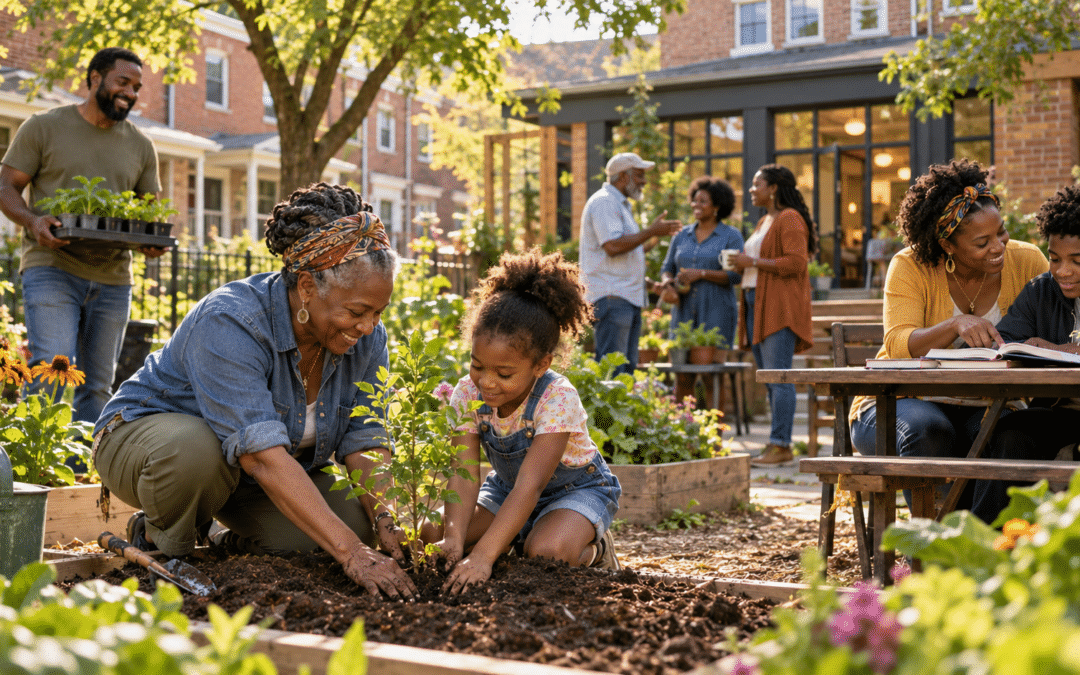
Our utopia has to be a place we can build toward. It should give Black families more freedom to choose their futures and more security in the places they call home. Over the past year, people and institutions across the United States have made that horizon more visible. Some gains were celebrated with ribbon cuttings. Others arrived through a hard-won vote or the patient recovery of a family story.
The twenty stories that follow come from the ten states with the largest Black populations. Together, they offer a hopeful record of work accomplished between October 26, 2025, and October 26, 2026. None asks us to pretend that injustice has disappeared. Each gives us something real to recognize and carry forward.
Texas
In Dallas, descendants are helping decide how their community will be remembered. The Tenth Street Historic District Digital Museum launched on April 15, 2026, opening a public doorway to oral histories, photographs, maps and family-held records. Cousins Tameshia Rudd-Ridge and Jourdan Brunson, co-founders of the family-history technology company kinkofa, led the work with community collaborators. The Library of Congress identifies Rudd-Ridge as a descendant of Tenth Street, a settlement established after emancipation by formerly enslaved people. The museum gives a historic Black community greater power to preserve and share its own record. Library of Congress account.
Houston’s Sunnyside neighborhood gained something equally necessary: room to enjoy being alive. Hill at Sims celebrated its opening on May 30, 2026, transforming a stormwater detention landscape into a 100-acre public park while retaining its flood-control function. Almost five miles of trails, fishing access, overlooks and outdoor learning space now invite everyday use. More than 700 residents contributed ideas through over 20 community meetings. Houston Parks Board describes it as Sunnyside’s first new park in nearly 50 years. For a historic Black neighborhood, investment in beauty and recreation is a meaningful part of a flourishing future. Houston Parks Board completion announcement and opening confirmation.
Florida
In Fort Pierce, the Florida Highwaymen Museum opened in February 2026, followed by its formal grand opening on May 20. Its gallery represents all 26 Black artists whose luminous landscapes became both creative expression and a livelihood under segregation. Excluded from conventional galleries, they sold paintings along highways and from their cars. The museum gives that resourcefulness a permanent home in the Lincoln Park neighborhood. Families who remember the artists’ working lives can now see their legacy encountered by new visitors. A place on the wall becomes a place in the city’s understanding of itself. Fort Pierce museum announcement and WQCS artist-family reporting.
In Daytona Beach, Bethune-Cookman University’s Master of Science in Nursing Education earned initial national accreditation on April 2, 2026. The online program prepares registered nurses to teach and mentor the next generation, extending the influence of their experience beyond individual patients. Its significance also rests in the institution behind it: Mary McLeod Bethune, a daughter of formerly enslaved parents, built an educational mission against formidable exclusion. This year’s achievement carries that mission into the preparation of future nursing educators. Bethune-Cookman program and accreditation details and the university’s founding history.
New York
Brooklyn’s Weeksville offered a welcome reminder that Black freedom has a built history worth caring for. A $4 million restoration of the Hunterfly Road Houses was completed in February 2026, repairing exteriors and improving safety systems and collections storage. Weeksville began in 1838 as an independent Black landowning community, decades before the Civil War. The historic landscape makes freedom tangible through domestic life. The houses show how Black Americans shaped a shared future even when the country refused to recognize their full belonging. New York City restoration announcement and Weeksville’s own history.
Across the city, the Studio Museum in Harlem reopened to the public on November 15, 2025, in its new home on West 125th Street. The seven-floor building brings expanded galleries, studios and educational spaces to an institution rooted in Harlem since 1968. Its opening exhibition honored Tom Lloyd, whose electronically programmed light sculptures broadened the possibilities of Black artistic expression. The museum’s mission reaches across the African diaspora, while its relationship with Harlem remains essential. After a long construction closure, a beloved cultural institution could welcome people back, with more space for artists and neighbors to encounter one another. Opening announcement, museum reopening confirmation and Tom Lloyd exhibition.
Georgia
On Sapelo Island, the promise of a future at home depends on residents being heard. On January 20, 2026, McIntosh County voters repealed a zoning change that would have permitted much larger houses in Hogg Hummock, the Gullah Geechee community descended from people enslaved on the island. Repeal prevailed by more than five to one after years of organizing, petitions and litigation. The victory was substantial, though unfinished: replacement zoning adopted in August drew new concerns from residents. Their successful referendum remains evidence of collective power in a place where land and cultural survival are closely joined. The Current election report and Atlanta Journal-Constitution follow-up.
In Decatur, September brought breathing room for Beacon Hill, a historic Black neighborhood largely erased by urban renewal. On September 8, the school board halted plans for a new early-learning building on community greenspace, choosing to pursue expansion at an existing facility. Black community organizations had persistently advocated for the site, with support from the Muscogee (Creek) Nation. Educational and financial considerations also figured in the decision. The land’s eventual use remains unresolved, so this was no permanent preservation guarantee. Still, one construction proposal ended, leaving more room for residents to defend a place of gathering and remembrance. School district decision and Mvskoke Media community reporting.
California
San Francisco baker Azikiwee “Z” Anderson opened Rize Up’s Test Kitchen Café on September 10, 2026, after years of delays and setbacks. His sourdough business now had a place where customers could sit together, and community donations had helped construction move forward. Anderson’s relationship with the city makes the opening especially moving. He arrived from New Orleans with his family as a child, experienced homelessness and later donated bread to organizations that had helped feed him. The new café adds a gathering place to that circle of care. It is a business achievement with an unmistakably human center. SFGATE opening report and San Francisco Standard profile.
In South Los Angeles, AMAAD celebrated acquiring the Watts Civic Center building at a November 21, 2025, open house. By December, local reporting also confirmed the opening of its Behavioral Health Peer Support Center. The organization describes its therapy and peer-support work as focused on healing trauma in Black communities. Owning the building gives that community-based work a firmer physical foundation, even as a larger renovation remained ahead. A local organization secured space and opened another door through which people could seek culturally responsive support close to home. AMAAD acquisition celebration, Los Angeles Sentinel report and AMAAD’s community mission.
North Carolina
At North Carolina A&T State University, the future acquired more room to grow when a $63 million gift from MacKenzie Scott became the largest single contribution in the university’s history. Announced on November 14, 2025, the unrestricted gift gives the Greensboro institution discretion over how to strengthen student success and research. The university described ambitions spanning engineering, agriculture, health and artificial intelligence. The achievement is the investment itself, placed in an institution founded for Black education whose students helped ignite the Greensboro sit-ins. A&T has a long practice of enlarging what is possible. North Carolina A&T gift announcement and university history.
In Raleigh, another kind of inheritance entered public view on July 2, 2026, when the Gregg Museum opened Community Stories: Sustaining North Carolina Black Heritage. The exhibition connects family enterprise, dressmaking, books and agriculture through the people who have carried those histories forward. Among its collaborators is Black Farmers Hub owner Demetrius Hunter, whose ancestors were enslaved at the Spring Hill plantation site now within Dix Park. That relationship is documented in the city’s interpretation plan. Here, a descendant helps shape the telling rather than appearing only as the subject of someone else’s account. The exhibition makes room for living custodians of Black memory. Gregg Museum exhibition and Dix Park Cultural Interpretation Plan.
Maryland
Sometimes the future depends on keeping a house standing in the public imagination. On March 24, 2026, Montgomery County’s council unanimously gave historic protection to the Rose-Budd House in Sandy Spring. Educator Perry Budd built it around 1912, and it has remained almost continuously in his family, with women playing a central role in that continuity. The Budds’ local roots reach into the early 1800s and the establishment of Sandy Spring’s free Black communities. The designation recognizes a family whose contributions to schools, churches and skilled trades helped sustain a community. A home of ordinary scale can hold an extraordinary share of a people’s story. Montgomery Planning history and designation.
Frederick gained another home for remembrance when the African American Heritage Center opened on October 17, 2026. The project grew from the work of the African American Resources Cultural and Heritage Society, founded by historian Bill Lee in 2001. Its exhibits preserve the texture of local Black life through church history, voting rights, oral histories and artifacts from the segregated Lincoln School. A recreated barbershop includes Petey Sewell’s original chair. Such objects help a community recognize itself across generations. A quarter century of organizing has given residents a lasting place to encounter histories that belonged to Frederick all along. WYPR’s account of the center and post-opening local report.
Illinois
On Chicago’s West Side, the Sankofa Village Wellness Center opened in West Garfield Park on April 23, 2026. The 60,000-square-foot building brings together space for medical care, mental-health support, fitness and community resources in a predominantly Black neighborhood. The Garfield Park Rite to Wellness Collaborative holds part ownership, joining partners including Rush, Erie Family Health Centers and the YMCA. Erie’s care is designed to serve people regardless of insurance or ability to pay. The center establishes a substantial neighborhood resource shaped around residents’ wellbeing and participation. Rush account of the opening and partnership.
Farther north, Chicago artist Theaster Gates acquired Pickard China, the historic porcelain manufacturer in Antioch. Employees learned of the purchase in early September 2026. A trained ceramicist, Gates took on a working business whose skilled employees preserve generations of craft knowledge. His own family history connects Mississippi to Chicago through the Great Migration, a history that also informs his artistic work. Repairs and a difficult fine-china market still present challenges, so a turnaround cannot yet be declared. The completed acquisition nevertheless places an established American craft enterprise under the stewardship of a Black artist with a deep interest in preserving useful traditions. NPR reporting and Gates family and artistic history.
Virginia
In Williamsburg, hundreds gathered on October 9, 2026, to rededicate the reconstructed African Baptist Meeting House. The congregation began in 1776 with enslaved and free Black worshippers who met despite laws restricting their assembly. Reconstructing its first permanent home brought Colonial Williamsburg specialists together with descendant congregations, whose participation helped guide how the history would be presented. Finishing touches still remained at the dedication, but the public milestone was real. On ground where Black people once had to insist upon their right to gather, their descendants helped restore a visible place for that faith and resourcefulness. Associated Press report and Colonial Williamsburg’s reconstruction account.
Elsewhere in Virginia, the future took the form of land. In May 2026, the Capital Region Land Conservancy announced the completed transfer of 61 acres in Varina to the Central Virginia Agrarian Community Land Trust. More than 54 acres are prime farmland. The community organization works to expand land access for Black farmers and other farmers of color, in a majority-Black neighborhood. A $400,000 Virginia Outdoors Foundation grant helped make the transfer possible. Agricultural training and broader food access remain goals to build upon this foundation. What changed this year was ownership: land became an asset held by an organization committed to cultivating opportunity. Capital Region Land Conservancy transfer announcement.
Pennsylvania
In Pittsburgh, Black Brewhouse opened in April 2026 as a shared tasting space for Black-owned beverage businesses. Erika Turner of TLC Libations and Marcus Wyatt of Windy Bridges Brew joined forces in a downtown storefront, creating another route for small producers to reach customers. Their leased space offers a shared platform rather than the burden of separate storefronts. Wyatt’s Pittsburgh family includes a grandfather who served as a steelworkers’ union official. A new generation is adding entrepreneurship and hospitality to the region’s long story of Black work. Pittsburgh Magazine opening coverage, the operating business and Wyatt’s family background.
In the Hill District, the New Granada’s restored marquee illuminated another new beginning on August 12, 2026. Phase I of the landmark’s revival was complete, and the University of Pittsburgh’s Hill District Community Engagement Center opened inside. Facade restoration and structural work accompanied new spaces for learning, including classrooms and a STEAM studio. The full theater redevelopment was not complete. Still, a building deeply connected to Black Pittsburgh’s cultural life was receiving people again, with resources for everyday community use. There is hope in that combination: a familiar landmark made useful to the people who will write the neighborhood’s next chapter. Hill Community Development Corporation project update and New Pittsburgh Courier opening report.
A Future We Can Help Build
These stories suggest where our attention and support can go. We can visit the institutions keeping community memory alive, spend with the entrepreneurs making room for others, and learn from neighbors who organize around the places they love. The gains differ in scale, and some remain vulnerable. Yet they belong in our understanding of Black American life. Our utopia is taking root wherever people gain a greater say in the future and build something worth passing on.
About This Selection
The states appear in descending order of total residents identifying as Black alone or in combination with another race, using the Census Bureau’s July 1, 2025, estimates. This is a population ranking, not a ranking by percentage or ancestry. Selection prioritized documented connections to descendants of U.S. slavery and longstanding Black American communities; it does not establish every participant’s genealogy. Historical background may predate the reporting window, but each featured milestone falls within it. Census Bureau state population estimates.