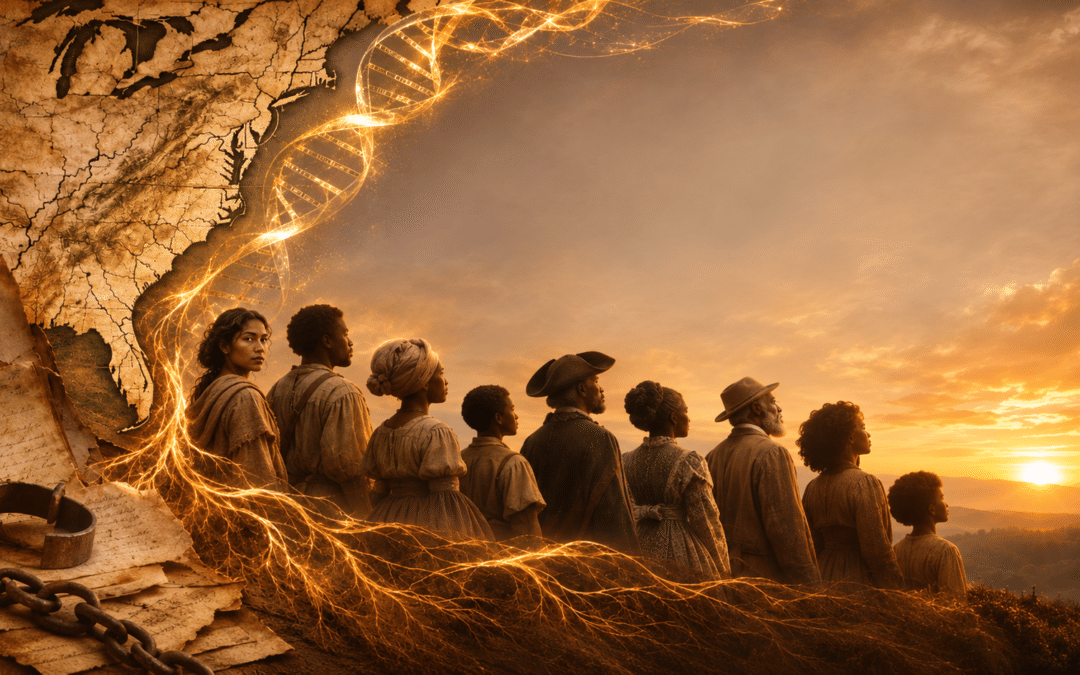
Our origins may be richer than we were taught.
What if some Indigenous peoples declared extinct by colonial authorities never actually disappeared? What if their descendants survived through enslavement, migration, intermarriage, and eventual incorporation into what became the Black American ethnicity? And what if the stories our great-grandparents repeatedly told us about having “Indian blood” contain historical evidence that has never received the serious investigation it deserves?
These questions are not intended to manufacture ancestry or rewrite history to satisfy a preferred narrative. They are questions that demand scientific and historical investigation. At Newbeings 1619, we recognize Black Americans as a distinct people formed through an extraordinary process of accelerated ethnogenesis involving Indigenous, African, and European peoples. Yet the Indigenous contribution to that formation remains one of its least understood dimensions.
Historical evidence establishes that Indigenous people were enslaved alongside Africans, that some Indigenous descendants entered populations classified as Black, and that government authorities sometimes deliberately erased Indigenous identities from official records. Genetic research confirms that Indigenous ancestry is present among Black Americans. Increasingly sophisticated research into the earliest populations of the Americas is also revealing ancestral relationships that earlier scientific models failed to explain.
Perhaps the story of our origins is not wrong. Perhaps it is incomplete.
Before 1619, Indigenous People Were Already Being Enslaved
The conventional telling of American slavery often begins in 1619, when captive Africans arrived in English Virginia. However, slavery in the Americas did not begin there. Following European arrival in 1492, Indigenous peoples throughout the Caribbean and the Americas experienced kidnapping, forced labor, and enslavement.
In 1614, English explorers abducted members of the Patuxet community of the Wampanoag people and transported them across the Atlantic. These events preceded the arrival of captive Africans in English Virginia. Africans had also arrived earlier in Spanish colonial expeditions. In 1526, approximately 100 enslaved Africans were brought to the short-lived settlement of San Miguel de Gualdape, probably located along the southeastern Atlantic coast. Some rebelled and escaped, potentially finding refuge among nearby Indigenous peoples. Thus, Indigenous and African experiences of enslavement were already overlapping long before the establishment of the United States.
Historical documentation identifies members of numerous Indigenous nations and communities who were enslaved during the colonial period, including the Wampanoag (including Patuxet), Pequot, Narragansett, Nipmuc, Tuscarora, Apalachee, Timucua, Guale, Yamasee, Natchez, and Sewee. These names represent distinct histories. Some people were captured in colonial wars, others were abducted in slave raids, and still others were sold through trading networks involving Europeans and their Indigenous allies.
Historian Alan Gallay’s research estimates that tens of thousands of Indigenous people were enslaved in the English colonial Southeast between 1670 and 1715. Some were exported to the Caribbean and other colonies, while others remained in North America. Their descendants did not all follow a single historical path, but their enslavement raises a question that belongs directly in the history of Black American ethnogenesis: What became of Indigenous people who remained in the colonies, especially those whose children and grandchildren entered enslaved populations increasingly classified as Black?
Sources: Smithsonian National Museum of the American Indian; Alan Gallay, The Indian Slave Trade.
The Tribes Declared Extinct: Where Did Their Descendants Go?
Colonial records repeatedly describe Indigenous communities as having vanished. But there is an important difference between the disappearance of a political or tribal identity and the biological disappearance of every descendant. Epidemics, warfare, enslavement, displacement, assimilation, and racial reclassification could destroy a community’s recognized political existence without eliminating all the people descended from it.
The Chowanoke (Chowan), North Carolina
The Chowanoke maintained a distinct community for generations after European contact. Their remaining communal reservation land was lost in 1821, after which their earlier political organization ceased functioning as a separate tribal unit. However, archaeological and genealogical research demonstrates that Chowanoke descendants continued living in the region and entered other communities. Some descendants today continue efforts to preserve and restore Chowanoke identity.
The Weapemeoc, North Carolina
The Weapemeoc confederation included the Pasquotank, Perquimans, Poteskeet, and Yeopim peoples. After epidemics, displacement, land loss, and assimilation, their separate tribal identity was no longer officially recognized by the 1730s. Historical research describes how they gradually became indistinguishable from surrounding populations in colonial records, leaving important questions about the identities and destinations of their descendants.
The Coree, North Carolina
The Coree were among the Indigenous coastal peoples who experienced devastating population losses and displacement. Their subsequent history is difficult to reconstruct because of the scarcity of records. The National Park Service acknowledges that survivors of some devastated coastal North Carolina communities entered other Indigenous nations as well as nearby Black and white populations. This historical pattern deserves greater attention in genealogical investigations of regional Black American families.
The Sewee, South Carolina
The Sewee experienced catastrophic population decline. Historical accounts describe survivors of a failed maritime expedition being captured and sold into slavery in the West Indies. By the early eighteenth century, the Sewee had ceased functioning as a separately identifiable nation, with remaining members absorbed into other Indigenous communities. Their history illustrates how enslavement, displacement, and absorption could obscure a people’s descendants.
The Timucua, Florida and Georgia
The Timucua-speaking peoples once occupied a large portion of northern Florida and southern Georgia. European disease, warfare, enslavement, and colonial displacement devastated their populations. By the nineteenth century, no separate Timucua political community remained. However, the National Park Service documents that survivors entered other Indigenous populations, including the Seminole and Muscogee, while others were taken to Cuba.
These examples do not prove that every community contributed ancestry to Black Americans. They establish something equally important: historical disappearance does not necessarily mean that every descendant died. The same inquiry should be extended to other communities whose identities became difficult to trace, including the Neusiok, Machapunga, and several coastal South Carolina peoples.
Could descendants of some of these communities have survived within the enslaved populations that eventually formed Black America? The historical record leaves that possibility open, although particular ancestral connections must still be demonstrated through evidence.
Sources: University of North Carolina, Chowanoke research; North Carolina Department of Natural and Cultural Resources, Weapemeoc; National Park Service, Native Americans of the South Outer Banks; South Carolina Encyclopedia, Sewees; National Park Service, What Happened to the Timucuan People?.
When the Government Erased Indigenous Identity
Some ancestral identities were not simply forgotten. They were deliberately changed, and Virginia provides a particularly disturbing documented example. Under the Racial Integrity Act of 1924, Virginia’s registrar of vital statistics, Walter Plecker, worked to impose a rigid racial classification system. Indigenous Virginians were frequently reclassified as “colored,” even when earlier records identified them as Indian.
Birth certificates and marriage records were altered, and officials were pressured to deny Indigenous classifications. The Library of Virginia documents these practices and their lasting consequences for Indigenous families attempting to reconstruct their genealogies.
Consider what this could mean across several generations. One ancestor might be recorded as Indian, their child as colored, their grandchild as Negro, and a later descendant as Black American. The family might preserve its Indigenous ancestry through spoken history while official documents present an entirely different classification. This is an illustration of a documented type of reclassification, not a claim that every family experienced this precise sequence.
Nevertheless, it exposes a fundamental weakness in treating historical paperwork as unquestionable truth. When governments have demonstrably rewritten people’s racial identities, official records cannot be the final authority on ancestral origins.
Source: Library of Virginia, Walter Plecker and the reclassification of Indigenous Virginians.
1808: When Human Reproduction Became an Increasingly Valuable Commodity
In 1807, President Thomas Jefferson signed legislation prohibiting the importation of enslaved people into the United States, effective January 1, 1808. The prohibition did not end slavery, and illegal international trafficking continued. However, it substantially changed the economics of the institution, as enslavers who could no longer legally import captive Africans increasingly relied upon the existing enslaved population to reproduce the workforce.
The reproductive capacity of enslaved women became even more economically important. Enslavers interfered with intimate relationships, encouraged or coerced reproduction, arranged pairings, and regarded children born into slavery as property with future monetary value. These abuses existed before 1808, but the expanding domestic market placed increasing value on the reproduction of enslaved people afterward. Historians have documented deliberate reproductive coercion, although the historical evidence for a widespread system of dedicated, industrial-style “breeding farms” remains limited. Much of the documented exploitation occurred within existing plantations and slaveholding households.
Meanwhile, the domestic slave trade expanded, forcibly moving enormous numbers of people from the Upper South into the cotton-producing Deep South. Families were separated, individuals were transported across enormous distances, and new family relationships developed under circumstances shaped by coercion and survival.
For the study of Black American origins, this leads to another question. If Indigenous ancestry was already present among enslaved populations before 1808, did subsequent generations of reproduction and forced migration spread those ancestral lineages across a much larger Black American population? Population growth would have multiplied descendants of existing ancestors, while migration could have redistributed those lineages geographically. The magnitude of any such Indigenous contribution remains a question for genealogical and genomic research.
Sources: National Archives, The Slave Trade; Slavery, Forced Intimacy and Reproduction, 1808–1861.
The Forgotten 1967 Study: Transferrin D1
On May 19, 1967, three researchers, A. C. Wang, H. E. Sutton, and I. D. Scott, published an intriguing scientific paper in the journal Science. Its title was Transferrin D1: Identity in Australian Aborigines and American Negroes, using terminology that reflects the original publication.
The researchers examined transferrin, a protein involved in transporting iron through the bloodstream. They found that a transferrin variant identified in an Aboriginal Australian sample exhibited the same amino-acid substitution previously observed in a Black American sample. Specifically, glycine replaced aspartic acid in the same analyzed portion of the protein.
The finding did not prove that the two individuals shared recent ancestry. Identical protein changes can arise through different evolutionary processes, and the study did not establish a migration between Australia and the Americas. Nor did the paper establish any relationship to the genetic population now called Population Y.
Nevertheless, the finding belongs in the historical record of scientific inquiry into population relationships. With genomic technologies vastly more sophisticated than those available in 1967, we should ask whether the relevant genetic variants have been investigated in sufficiently large and diverse datasets. Could renewed research clarify why that shared substitution appeared, and could it establish whether the observation has any meaningful relationship to Black American ancestral history? These questions must be answered through modern genetic analysis, not assumptions drawn from an old paper’s provocative title.
Population Y: An Ancient Ancestry That Complicates the Story
In 2015, a team of geneticists published a significant paper in Nature titled Genetic Evidence for Two Founding Populations of the Americas. The researchers identified an unexpected genetic signature among certain Indigenous peoples of South America. These populations shared more genetic variants with some present-day Australasian populations than other sampled Indigenous American populations did.
The researchers proposed that an ancient ancestral population contributed to the formation of certain Indigenous American groups. They called this inferred ancestral population Population Y, from a Tupi word meaning ancestor. This discovery complicated simplified explanations suggesting that all Indigenous Americans descended from a single, genetically uniform founding population.
The findings did not overturn the importance of ancient migrations through Beringia from northeastern Asia. Instead, they suggested that the ancestry of the Americas involved additional population structure and more complicated relationships among ancient Asian groups. Population Y has not been identified as a particular historical tribe, nation, or civilization. It is a genetic model of an ancient ancestral population that has not been directly sampled as a complete population, and it cannot be assigned a reliable physical appearance from these genetic relationships alone.
Who Today Carries the Population Y Genetic Signal?
There are living Indigenous populations in which researchers have detected excess genetic affinity associated with Population Y ancestry. However, no present-day people can simply be identified as the Population Y people, because the inferred ancestral population existed thousands of years ago.
Research published in 2015 and expanded in 2026 identifies the signal among several present-day Indigenous South American populations, including the Karitiana, Suruí, Guarani, Awajún, Ayoreo, Sirionó, and Tsimané. Earlier studies also identified relevant affinity among the Xavante and Piapoco. These are living Indigenous peoples whose genetic histories contain evidence relevant to the Population Y hypothesis, not populations whose entire ancestry derives from Population Y.
A major study published on April 22, 2026, in Nature, titled The Evolutionary History and Unique Genetic Diversity of Indigenous Americans, reported further evidence of this ancient Australasian-related ancestry. The study investigated the distribution of the signal and whether natural selection helped preserve certain genomic regions. Population Y is therefore not merely an abandoned scientific curiosity from 2015. It remains an active subject of research into the earliest ancestry of the Americas.
What About the Aeta of the Philippines, Papuans, and Aboriginal Australians?
The connection to living populations outside the Americas requires careful explanation. The original 2015 study found statistically significant excess genetic affinity involving several populations outside the Americas, including the Mamanwa of the Philippines, the Onge of the Andaman Islands, Papuan and other New Guinea populations, and sampled Indigenous Australians.
These groups served as genetic comparisons that helped researchers identify the unexpected ancestral signal among Indigenous South Americans. They are not proven to be direct descendants of the precise Population Y population that contributed ancestry to the Americas.
The Aeta, including the Ayta Magbukon of the Philippines, are particularly interesting because genetic studies demonstrate deep Australasian-related ancestry. Research published in 2021 also reported unusually high levels of Denisovan ancestry among Ayta Magbukon individuals. However, Denisovan ancestry is a separate genetic phenomenon from Population Y. The 2026 research specifically found that the two signals could not simply be treated as the same ancestral source.
Thus, Aeta populations deserve consideration when comparing deep Asian and Australasian population histories, but their inclusion must not be misrepresented as confirmation that they are Population Y.
What About Samoans and Other Polynesian Peoples?
Polynesian ancestry also has a complex history involving ancient Asian and Oceanian populations. The 2015 Population Y study included Tongans among its comparisons, but the observed result for them did not reach the study’s principal statistical threshold. There is no established finding identifying Samoans as descendants of Population Y.
Separately, a 2020 Nature study found evidence that Indigenous South Americans and eastern Polynesian peoples experienced contact around AD 1200. This is significant evidence of prehistoric connections across the Pacific, but it concerns a much later event than the ancient Population Y ancestry and does not establish that Polynesians brought Population Y ancestry into the Americas.
Shared ancient genetic relationships, later population contact, and direct ancestry from Population Y are three different questions. Treating them as interchangeable would create confusion where research should be establishing clarity.
Sources: Skoglund and colleagues, Nature, 2015; Castro e Silva and colleagues, Nature, 2026; Philippine Ayta and Denisovan ancestry, 2021; Prehistoric Native American and Polynesian genetic contact, 2020.
The Unanswered North American Question
The evidence for Population Y ancestry has been strongest among certain Indigenous South American populations. The original 2015 investigation did not detect the same significant genetic signal in the sampled northern and central North American populations. However, this does not demonstrate that the signal never existed anywhere in North America.
Ancient migrations into South America involved movements through or from northern parts of the continent. Yet the exact routes, timing, and population histories associated with the Population Y signal remain incompletely resolved. This creates a question of particular importance for Newbeings 1619:
If Population Y ancestry reached South America through ancient migrations across North America, did ancestral populations carrying this genetic signature also inhabit what is now the southern United States? And might any traces have survived among Indigenous communities later absorbed into populations classified as Black?
That question should be investigated, particularly in Virginia, North Carolina, South Carolina, Georgia, Florida, and the Gulf Coast. These regions possess extensive historical evidence of Indigenous enslavement, population displacement, and contact between Indigenous and African-descended peoples.
Existing research does not establish Population Y ancestry among the historical Indigenous nations of these regions or their Black American descendants. But the absence of conclusive evidence should not be mistaken for a completed investigation. The necessary work would involve carefully selected ancient and modern DNA datasets, genealogical research, relevant historical records, and collaboration with descendant communities and Indigenous nations. The goal would be to determine whether such ancestry existed, not to assume in advance that it did.
Our Great-Grandparents’ Testimony Deserves Reexamination
Across Black America, families have passed down accounts of Indigenous ancestry. Many of us recognize the familiar words, “Your grandmother was Indian,” or “Your great-grandfather had Indian blood.” Some accounts identify particular tribes, while others preserve locations, surnames, physical descriptions, or stories about ancestors whose identities changed over time.
Not every such account will be historically correct. Family memory is imperfect, and historical stories can be altered by repetition, social pressures, and misunderstandings. But oral testimony is not invalid simply because it was never placed in an official document.
A particularly important avenue of investigation involves independent attestation. If multiple families with no meaningful contact independently preserve similar ancestral accounts, that deserves examination. Researchers must first establish whether the accounts truly developed independently, because similar stories alone cannot prove a shared historical origin. Where independence can be established, however, the convergence becomes valuable evidence that may guide further research.
Could some of these stories preserve memories of Indigenous ancestors who entered enslaved communities? Could some refer to descendants of Indigenous nations that lost their separate political identities? Could others preserve ancestral relationships that do not fit the racial categories imposed by colonial society?
We must also consider the changing meaning of the word Indian. Historical speakers used that term in different ways, sometimes referring to specific Indigenous nations and sometimes using broad racial or geographic descriptions. It is reasonable to ask whether different family traditions used the same word to mean different things. However, there is currently no evidence that Black American elders used “Indian” to specifically identify the ancient genetic population now called Population Y.
We must not impose a modern scientific label on their testimony without evidence. Instead, we should recover the original meaning as carefully as possible. Our ancestors may have preserved pieces of a history that institutional records failed to protect. Those pieces deserve investigation, not automatic acceptance or automatic dismissal.
How Much Indigenous Ancestry Do Black Americans Actually Have?
There is already genetic evidence of Indigenous ancestry among Black Americans. A 2015 study published in The American Journal of Human Genetics analyzed genetic ancestry among thousands of self-identified African Americans. Within its sampled population, researchers estimated an average of approximately 0.8% Indigenous American ancestry. They also found substantial variation by geography and between individuals, with some participants carrying considerably higher estimated proportions.
This finding is important because it demonstrates that Indigenous genetic contributions to Black American ancestry are real and measurable. However, it does not identify every historical Indigenous source population, nor does it mean that all Black Americans have the same ancestry or that the study sample perfectly represents the entire population.
Modern ancestry estimates also depend upon the reference populations available to researchers. This creates another research opportunity: Could historical Indigenous ancestry among Black Americans be more precisely identified through expanded reference datasets, particularly those representing populations that disappeared from colonial classifications? And could research eventually determine whether any of that ancestry carries the Population Y signal? At present, that final connection has not been established.
Spoken History Is Evidence. Written History Is Not Gospel.
At Newbeings 1619, we acknowledge spoken history as a legitimate source of historical evidence. We recognize that knowledge can be transmitted across generations without ever being entered into an official archive. We also recognize that a government document, university publication, or historical textbook is not automatically truthful simply because it exists in writing.
Written history can contain prejudice, omission, misclassification, and deliberate falsehoods. Spoken history can contain accurate testimony, misunderstanding, exaggeration, and forgotten details. Neither deserves blind acceptance, and both deserve examination.
Our protocols for evaluating spoken history require preserving the original account, identifying its source and transmission, seeking independent corroboration, comparing available written evidence, and separating documented conclusions from provisional interpretations. Genetic evidence should be added where appropriate, with informed consent, respect for Indigenous data sovereignty, and recognition that ancestry does not independently establish citizenship or membership in an Indigenous nation.
No single form of evidence should be treated as infallible. Our principle remains THE RECEIPTS ARE THE STANDARD. But the receipts must themselves survive rigorous examination.
The Investigation That Must Now Begin
The history of Black American ethnogenesis is not simply the history of Africans brought to America and their descendants. It is the history of a new people formed through slavery, forced migration, resistance, survival, family formation, and the interaction of multiple ancestral populations.
The African contribution remains fundamental, the European contribution is documented, and the Indigenous contribution is established. Yet many specific Indigenous ancestral histories and source populations remain unresolved, and understanding them could significantly enrich our understanding of Black American formation.
A serious research initiative should concentrate on reconstructing Indigenous lineages within historically enslaved populations, especially in the Chesapeake, Carolinas, Georgia, Florida, and Gulf Coast. It should examine communities whose official tribal identities disappeared while descendants survived, investigate historical reclassification, compare family oral testimony with regional genealogies, and trace the consequences of forced migrations.
The investigation should also revisit the 1967 transferrin research using modern scientific knowledge and examine the implications of Population Y research without mistaking intriguing possibilities for established facts. This work must respect living Indigenous nations and their authority over their own histories, cultural identities, and ancestral remains. A fuller understanding of Black American ancestry should never come at the expense of another people’s identity.
We Are Not Inventing an Origin. We Are Investigating What History May Have Left Out.
We cannot claim that all Indigenous nations described as extinct became part of Black America. We cannot claim that our great-grandparents’ references to Indian ancestry meant Population Y, nor can we claim that the 1967 transferrin findings prove a direct ancestral connection between Black Americans and Aboriginal Australians. Those claims exceed the available evidence.
But we can establish that Indigenous enslavement preceded 1619 and that Indigenous and African-descended peoples shared experiences of captivity, resistance, and community formation. We can establish that some Indigenous descendants entered populations classified as Black and that governments sometimes falsified or altered ancestral identities. We can establish that genetic studies detect Indigenous ancestry among Black Americans and that scientific discoveries continue to complicate our understanding of America’s earliest ancestral populations.
These are sufficient grounds for a serious, disciplined research initiative. Some ancestors may have survived under different names, while others may have become part of communities that no longer remembered their original tribal affiliations. Some may have carried ancestral knowledge forward through spoken history when written records failed or deliberately misrepresented them. The full extent of those histories remains unknown, and that uncertainty is precisely why the investigation must continue.
At Newbeings 1619, we recognize Black Americans as a people in our own right, formed by history but not confined to the explanations history has handed us. We seek neither borrowed identities nor comforting myths. We seek a more complete understanding of the extraordinary process that produced us.
Our origins may be richer than we were taught.
And understanding those origins may illuminate not only where we came from, but the possibilities of who we are becoming.
We innovate, or we dissipate.
Principal Research Sources
Historical evidence: Alan Gallay, The Indian Slave Trade; Smithsonian National Museum of the American Indian; National Park Service, Native Americans of the South Outer Banks; University of North Carolina, Chowanoke research; Library of Virginia, Walter Plecker.
Slavery and reproduction: National Archives, The Slave Trade; Slavery, Forced Intimacy and Reproduction, 1808–1861.
Population genetics: Wang, Sutton, and Scott, Transferrin D1 (1967); Skoglund and colleagues, Genetic Evidence for Two Founding Populations of the Americas (2015); Castro e Silva and colleagues, The Evolutionary History and Unique Genetic Diversity of Indigenous Americans (2026); Philippine Ayta genetic history (2021); Polynesian and Indigenous American contact (2020); Bryc and colleagues, Black American genetic ancestry (2015).