
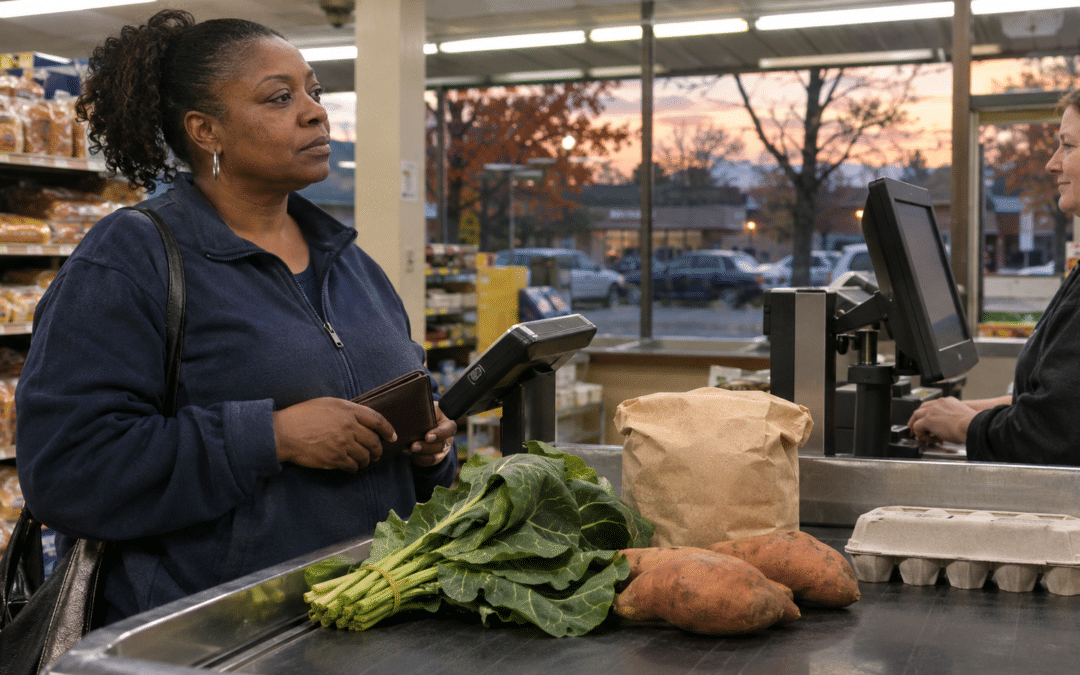
A new Gallup report found that three in ten Black adults had come up short on food money at least once in the previous year. Just before Thanksgiving, the numbers raise an uncomfortable question: What should a shift be enough to buy?
You can spend eight hours making sure nobody leaves hungry and still stop at the grocery checkout to do the math. The greens cost what they cost. The rent is due when it’s due. The shift you were counting on next week? That’s the number you don’t know yet. There is a particular insult in putting something back when you’ve spent the day bringing plates to other people.
That scene is an illustration, not a story from the survey. But the contradiction is real. Gallup’s November 23 report found that 30% of Black adults said there had been a time in the previous 12 months when they lacked the money to buy needed food. The shares were 24% among Hispanic adults, 14% among white adults and 10% among Asian adults. Among workers, across racial groups, 30% of those in hospitality and 28% in retail reported this experience. Those are separate findings. The fact that two of the numbers match does not tell us how many Black hospitality workers went without money for food.
A paycheck is a promise with a date on it
Gallup surveyed 5,065 U.S. adults from May 28 to June 5, 2026. It asked about a shortfall at any time in the previous year. It did not count skipped meals or measure Thanksgiving grocery prices. But it gives us a reason to look at what a monthly or annual income figure can hide: a person can make enough on paper and still not have enough on the day a bill comes due. A week of cut shifts, a car repair or a sick child can turn groceries into the one part of the budget that can be put back.
And this is bigger than one survey. In its separate 2024 household food security report, the USDA found that very low food security among households with a non-Hispanic Black reference person rose from 8.7% in 2023 to 10.5% in 2024. That is a more severe measure, tied to disrupted eating and reduced food intake, and it isn’t interchangeable with Gallup’s. What neither source lets us see is which work and scheduling conditions leave Black Americans descended from U.S. slavery most exposed in particular communities. At the time of this writing, I found no such breakdown in the published figures. That is a gap Newbeings 1619 seeks to help fill, without asking anyone to put their private financial circumstances on display.
A holiday food box helps. So does knowing next week’s hours.
If food is the immediate problem, start there. Search by ZIP code through Feeding America’s food-bank finder or WhyHunger’s food directory. WhyHunger also accepts ZIP codes by text at 1-800-548-6479. Call the pantry or meal site before you travel to confirm holiday hours, pickup rules and what is available.
If you set schedules, treat time as part of compensation. Post schedules earlier, give people a dependable floor of hours where possible, and ask them before cutting a shift they have already planned around. If you’re organizing with coworkers, start with one concrete demand, such as a schedule posted two weeks in advance. Keep your own records of last-minute changes if you can do so safely. It’s hard to show what unstable work costs when every canceled shift is treated as a separate surprise.
If you’re organizing locally, ask who can actually get to the food. A pantry open only during the workday can be out of reach for the people who need it. Ask a pantry and a neighborhood group whether they can test one evening pickup or a site near a bus route. On the Newbeings 1619 social platform, share verified pickup hours, transit directions and scheduling practices that worked. Share the resource, not somebody else’s hardship.
There will be somebody working tomorrow so that somebody else can eat well. The question worth carrying past Thanksgiving is whether we think that worker should have to wait for a holiday drive to do the same.
You carried plates through steam and light,
Then counted coins beneath the night.
Let work bring more than bread today:
A week you can plan, and hours that stay.