
Who Decided That Written History Was Automatically More Trustworthy?
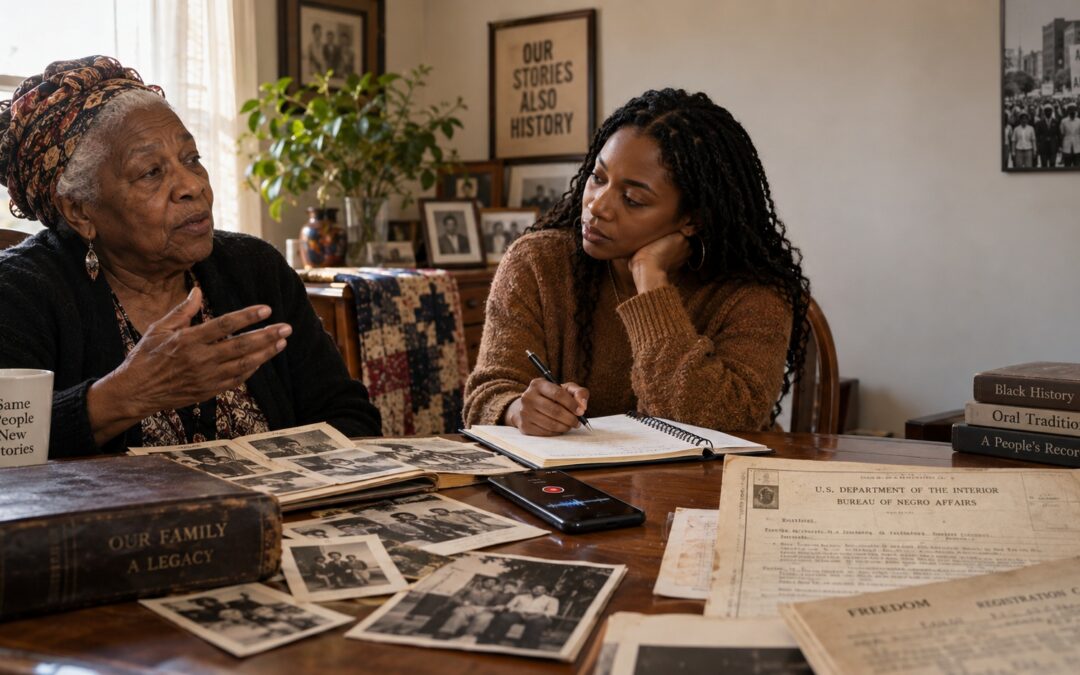
For generations, Black Americans have been asked to prove our history using records created by institutions that often had little interest in recording our experiences accurately. A document written in 1870 is routinely called a primary source. A story passed from a formerly enslaved great-grandmother to her daughter, then carefully preserved within a family, may be dismissed as anecdotal. That distinction deserves scrutiny.
Paper does not make a person unbiased. A government seal does not make a statement true. A newspaper does not become objective simply because someone preserved it in an archive. And the inability of an enslaved person to leave behind a written document should not grant greater historical authority to the person who enslaved them.
Black American oral history should not be accepted uncritically. Neither should written history. The proper standard is equality of scrutiny, not equality of weight. Oral testimony should be treated as admissible historical evidence whose reliability is assessed according to provenance, proximity, corroboration, independence, consistency, context, and known limitations.
Written records should not be presumed innocent while oral records are presumed guilty.
The Written Record Has Never Been Neutral
One of the central problems in historical research is so obvious that it is often overlooked: the people with the greatest ability to create and preserve records were usually the people with the greatest institutional power. During slavery, enslaved Black Americans frequently appear in written records because someone sold them, insured them, counted them, inherited them, transported them, punished them, or listed them as property. Those documents can be extremely useful, but they were created from a particular position of power.
A plantation ledger may be highly reliable for determining what an enslaver paid for a human being while being nearly useless for understanding what that person thought about family, religion, resistance, captivity, or freedom. The ledger is not worthless. It is simply fit for some historical questions and unfit for others. The same principle should apply to oral testimony.
When Respected Historians Got Black History Wrong
Consider Reconstruction. For decades, historians associated with Columbia University professor William A. Dunning helped shape a dominant interpretation that portrayed Reconstruction largely as a disastrous period of corrupt government, incompetent Black political participation, Northern interference, and white Southern victimization. These ideas were not confined to obscure pamphlets. They circulated through respected universities, dissertations, books, classrooms, and the professional historical establishment.
Columbia University now describes the Dunning School as a white-supremacist reading of history that discredited Reconstruction and gave intellectual cover to Jim Crow. Modern scholarship has substantially revised that older interpretation by documenting Black political organization, constitutional reform, public education, civil rights activism, and efforts to build interracial democracy. Read Columbia University on the Dunning School and the Lost Cause.
The related Lost Cause narrative similarly minimized slavery, romanticized the Confederacy, distorted Reconstruction, and helped rationalize the rollback of Black civil and political rights. The National Park Service describes Reconstruction as a foundational struggle over citizenship and civil rights, including organized racial violence against Black Americans. The point is straightforward: history did not become accurate merely because credentialed people printed it.
National Park Service overview of Reconstruction and Ulysses S. Grant.
Wilmington, 1898: When the Newspaper Became Part of the Crime Scene
The Wilmington coup of 1898 provides an even sharper example. White supremacists in Wilmington, North Carolina, violently overthrew a legitimately elected biracial local government, killed Black residents, drove others from the city, destroyed the Black-owned Daily Record newspaper, and seized political control. Yet contemporary white newspaper coverage could frame the violence in a way that rationalized the seizure rather than neutrally documenting it.
On November 11, 1898, the News and Observer ran the headline “A Day of Blood at Wilmington” and told readers that Black residents had precipitated the conflict by firing on whites. The same front page described the replacement municipal government as new, conservative, and Democratic, and said the Board of Aldermen had been changed legally. A researcher who relied on that newspaper alone would possess a genuine written primary source, but would also possess a source produced inside the political and racial campaign surrounding the overthrow.
The original newspaper page is preserved by the Library of Congress in Chronicling America. View the November 11, 1898 News and Observer.
This is why the category written source cannot serve as shorthand for reliable source. Sometimes a historical document is valuable precisely because it reveals how an event was distorted, justified, or sanitized at the time.
Tulsa, 1921: A Written Record Can Spread the Lie
The Tulsa Race Massacre offers another example. After an encounter between Dick Rowland, a young Black man, and Sarah Page, a white elevator operator, the Tulsa Tribune published an inflammatory front-page article portraying Rowland as having attacked Page. The Library of Congress documents how that language helped create the impression of a sexual assault and how subsequent newspaper coverage often blamed Black residents for destruction carried out by white mobs.
Read the Library of Congress analysis of newspaper complicity and coverage in Tulsa.
White mobs destroyed much of Greenwood, one of the nation’s most prosperous Black communities. Tulsa historical institutions report that dozens of city blocks were ruined, hundreds of people were injured, and the death toll may have reached into the hundreds. Again, written records survived while many of the people whose homes and businesses were destroyed did not have equal opportunity to create or preserve the official record.
Explore the Museum of Tulsa History overview of the 1921 Tulsa Race Massacre.
Tulsa Also Shows What Oral History Can Do
For generations, oral accounts within Tulsa’s Black community maintained that massacre victims had been buried in mass graves. Such claims did not have to be treated as proven simply because they were repeated. But neither did responsible researchers need to dismiss them because archival documentation was incomplete. Oral tradition can generate a testable historical hypothesis: this is what people remember, so where should we look for corroborating evidence?
That distinction is essential. The responsible response to an oral claim is not, “Our elders said it, therefore it is true.” Nor is it, “There is no document, therefore it did not happen.” The stronger response is, “This testimony is evidence. Now investigate it.”
The WPA Slave Narratives Reveal an Even Deeper Problem
Between 1936 and 1938, the Federal Writers’ Project interviewed formerly enslaved Americans and created one of the most important collections of firsthand testimony about American slavery. But the collection itself demonstrates why the production of a historical source matters. Many interviewers were white, some were connected to former slaveholding families, and the elderly Black interviewees were speaking within the racial order of the Jim Crow South.
The Library of Congress explicitly warns that interviewer race affected at least some answers. In one analysis cited by the Library, 72 percent of former slaves interviewed by white interviewers rated the quality of their food under slavery as good, compared with 46 percent of those interviewed by Black interviewers. Likewise, 26 percent of those responding to white interviewers expressed unfavorable attitudes toward former enslavers, compared with 39 percent of those responding to Black interviewers.
Read the Library of Congress discussion of the limitations of the WPA Slave Narrative Collection.
The implication is profound. Even when Black people were finally allowed to tell their own stories, the process through which those stories entered the written archive could shape the data. Every source has a production history. We need to know who spoke, who asked the questions, who transcribed the answers, who edited them, what social pressures were operating, and what incentives shaped both speaker and recorder.
Black American Oral History Should Be Evidence, Not Gospel
A serious defense of oral history also requires acknowledging its weaknesses. Human memory is imperfect. People confuse dates, compress sequences, absorb stories they heard from others, exaggerate, omit details, reinterpret the past through later experiences, and sometimes simply lie. Trauma can affect memory. Repetition can reshape recollection. Interviewers can unintentionally lead witnesses. Family legends can accumulate details over generations.
Black people have no special immunity from the ordinary limitations of human memory. That is why oral history is strongest when it is treated as evidence to be investigated rather than as a sacred account that cannot be questioned. The goal is not to lower standards for Black history. The goal is to apply rigorous standards to every source, including the sources that traditional scholarship once treated as authoritative by default.
Our elders said it. Therefore it is evidence. Now investigate it.
A Black American Oral History Validation Standard
If oral testimony is going to help reconstruct history, evaluate claims, estimate losses, calculate patterns, support reparations research, establish genealogy, or map migration, it should be collected and evaluated systematically. The following framework treats oral history seriously without pretending that every recollection is equally reliable.
1. Identify the exact claim
Separate what a narrator personally witnessed from what they inferred, believed, or were told. “I watched them burn the building” is different from “my father told me they burned the building.” Both may matter, but they belong to different evidentiary categories.
2. Establish provenance
Record who provided the information, their relationship to the event, their age at the time, where they were located, when the testimony was recorded, who interviewed them, and how the account reached the present researcher. The chain of transmission is part of the evidence.
3. Obtain informed consent
Narrators should understand how recordings, transcripts, quotations, data, and conclusions may be preserved, analyzed, published, digitized, or shared. Ethical oral history requires transparency about purpose and future use.
4. Preserve the original recording
Whenever possible, retain the original audio or video together with the transcript. If artificial intelligence is used for transcription, the recording should still be preserved and the transcript manually reviewed. Future researchers should be able to return to what was actually said.
5. Separate firsthand testimony from inherited oral tradition
“I was there,” “my mother was there and told me,” and “my grandmother told my mother what her grandmother remembered” are not the same type of evidence. Multiple transmission steps do not automatically make a claim false, but they do affect how confidently it should be weighted.
6. Seek independent corroboration
Compare oral claims with census records, Freedmen’s Bureau documents, Freedman’s Bank records, military files, deeds, tax rolls, church records, photographs, maps, newspapers, court records, funeral programs, cemetery records, city directories, advertisements, insurance records, archaeology, and other independently sourced testimony. Oral evidence is often most powerful when it points researchers toward records they would not otherwise know to search.
7. Determine whether witnesses are truly independent
Five relatives repeating a story that all originated with the same grandfather are not five independent sources. They are five transmissions of one source. This distinction is especially important when oral testimony is used in probability estimates, scoring systems, or statistical models.
8. Investigate contradictions instead of hiding them
If one witness remembers ten businesses, another remembers twelve, a directory lists eight, and a map appears to show eleven commercial structures, do not simply choose the number that supports the preferred conclusion. The disagreement may reveal different dates, definitions, vantage points, incomplete records, faulty memory, or deliberate concealment.
9. Assign confidence instead of false certainty
Classify findings in transparent categories such as strongly corroborated, moderately corroborated, plausible, unresolved, disputed, unsupported, or contradicted. Explain why a claim received its classification. Historical uncertainty should be measured and disclosed, not concealed behind confident prose.
10. Preserve the audit trail
Future researchers should be able to see the original statement, when and how it was collected, what evidence supported it, what evidence contradicted it, what assumptions were made, and what remains unknown. That transforms oral memory into historical evidence with provenance.
These principles align with professional guidance from the Oral History Association on preparation, informed consent, interviewing, preservation, access, and responsible interpretation. Review the Oral History Association Principles and Best Practices.
Using Oral History for Assessments, Estimates, and Calculations
Oral history becomes particularly valuable when researchers are trying to reconstruct quantities that the surviving archive records poorly. Imagine an effort to estimate how many Black-owned businesses were destroyed in a particular community. An oral account identifies a grocery store missing from a city directory. A second independent witness remembers shopping there. A photograph shows the storefront. A newspaper advertisement gives an address. A property record identifies the owner. The oral testimony did not replace the documentary record. It helped researchers find and interpret it.
The same principle can support reparations research, wealth-loss estimation, genealogical reconstruction, migration analysis, community mapping, property research, demographic modeling, and other forms of quantitative historical work. Oral accounts can contain names, dates, locations, relationships, occupations, wages, prices, business ownership, property use, event frequency, community boundaries, and institutional relationships. Those details can become variables, provided researchers document how the data were obtained and how uncertain each item remains.
Use Ranges Instead of Fake Precision
Historical evidence is often incomplete. If several independent sources support a lower bound, other evidence supports a likely middle estimate, and less certain testimony suggests a higher figure, the result should be expressed as a range. A conservative estimate, central estimate, and upper estimate are often more honest than a single number with false decimal-point precision.
Use Confidence Weighting Carefully
A research project may choose to assign evidentiary weights to different classes of information, but those weights must be methodological tools rather than invented scientific constants. For example, independently documented facts might receive greater weight than a single uncorroborated multigenerational account. The exact scoring system matters less than publishing the rules in advance, applying them consistently, and allowing others to challenge them.
Conduct Sensitivity Analysis
Researchers should also ask what happens to a conclusion when uncertain evidence is removed or down-weighted. If excluding one disputed oral account changes a loss estimate from $20 million to $6 million, the result is highly dependent on that uncertain testimony. If the estimate changes from $20 million to $19.4 million, the conclusion is much more robust. Sensitivity analysis prevents uncertainty from being hidden inside an impressive-looking final number.
Absence From the Archive Is Not Evidence of Absence
Sometimes an event is missing from official records because it never happened. But sometimes it is missing because the institution responsible for creating records did not recognize Black life accurately, had incentives to conceal what happened, lacked interest in recording it, or destroyed the evidence. Enslaved marriages often lacked legal recognition. Black newspapers were destroyed. Black communities were displaced. Black testimony was discounted. Property rights were restricted. Some records disappeared, some were never created, and some survive only because someone outside the official system preserved them.
Historians should therefore distinguish between two very different statements: “There is no evidence this happened” and “We have not located surviving documentary evidence that this happened.” Oral history may be the evidence that tells researchers where to begin looking.
For post-emancipation research, the National Archives Freedmen’s Bureau collection is an example of how family relationships, labor, education, property, military claims, migration, and other details can sometimes corroborate oral accounts. Explore the National Archives Freedmen’s Bureau resources.
The Archive and the Ancestor Should Question Each Other
The goal is not to replace traditional archives with oral history. It is to construct a better evidentiary system. A grandmother’s recollection should be questioned. So should a sheriff’s report. A grandfather’s story should be corroborated. So should a newspaper article. A family tradition should be placed in historical context. So should a university historian writing during Jim Crow.
Government records, newspapers, photographs, archaeological evidence, letters, oral testimony, business records, genetic evidence where ethically appropriate, maps, legal documents, and family archives should be allowed to interrogate one another. No category of evidence deserves automatic innocence, and no category should be automatically disqualified simply because the information was spoken before it was written down.
Black American History Requires a Wider Evidentiary Lens
For much of American history, Black Americans were prevented from controlling the institutions that determined what became an official record. Later generations were then sometimes told that information outside those records could not be trusted because it was not documented. That creates a circular historical trap: first deny a people equal access to literacy, publishing, government, universities, journalism, archives, property rights, and institutional power, then ask their descendants to produce institutional documentation before their ancestors’ experiences will be believed.
That is not rigorous history. Black American oral history deserves a permanent place within the evidentiary system used to understand the Black American experience, not because oral history is perfect, but because no historical source is perfect. The responsible approach is to collect testimony ethically, preserve it accurately, triangulate it aggressively, disclose uncertainty, distinguish memory from inference, compare independent accounts, examine contradictions, and integrate oral testimony with every other available form of evidence.
Both should testify. Both should face cross-examination.
Where the archive contains gaps, distortions, omissions, propaganda, or outright lies, Black memory may contain evidence that history has been waiting generations to hear.
Frequently Asked Questions About Black American Oral History
Is oral history considered a valid historical source?
Yes. Oral history is an established historical research methodology. Its value depends on how testimony is collected, contextualized, preserved, corroborated, and interpreted. Professional standards emphasize informed participation, ethical interviewing, transparency, preservation, and responsible use.
Does oral history have to be independently verified?
Not every recollection can be independently verified, but claims capable of verification should be tested whenever possible. Unverified testimony can still be preserved and studied as long as its evidentiary status is described accurately.
Can family oral history be used in Black genealogy?
Yes. Family oral history can identify names, relationships, locations, occupations, churches, migration routes, former enslavers, military service, property, and other details that can then be compared with census records, Freedmen’s Bureau files, military records, deeds, church records, cemetery records, and other sources.
Can oral history be used in calculations or statistical analysis?
Yes, provided the methodology is transparent. Researchers should distinguish independent accounts from repeated versions of one originating story, document uncertainty, explain weighting rules, use ranges where appropriate, and test how uncertain evidence affects the final result.
Is written history more reliable than oral history?
Not inherently. Reliability depends on who created the source, why it was created, proximity to the event, access to information, bias, incentives, editing, preservation, and corroboration. The proper question is not whether a source was written or spoken. The proper question is how well that particular source supports the particular claim being made.
Conclusion: Record the Memory Before We Lose the Witnesses
There is urgency here. Every year, Black America loses elders who carry information that may exist nowhere else. Once they are gone, an entire historical archive can disappear with them. Families and communities should be recording neighborhood histories, migration stories, business histories, church histories, military experiences, civil rights experiences, labor histories, property stories, traditions, genealogies, community conflicts, victories, losses, and the texture of everyday life.
But preservation is only the beginning. We should document the origin of the testimony, test it, corroborate it, digitize it, protect it, cite it, and study it. When uncertainty remains, we should say so. When evidence conflicts, we should preserve the conflict rather than erase it. When oral testimony leads to documentary or physical evidence, we should record that chain of discovery.
Black American oral history should not sit outside history asking for permission to enter. Properly collected and responsibly evaluated, it is already part of the evidence.
Sources and Further Reading
Columbia Magazine, “The Battle for Grant’s Tomb”. Discussion of the Dunning School, the Lost Cause, Reconstruction historiography, and the changing reputation of Ulysses S. Grant. Open source
National Park Service, “A Short Overview of the Reconstruction Era and Ulysses S. Grant’s Presidency”. Overview of Reconstruction, Black citizenship, civil rights legislation, political participation, and racial violence. Open source
Library of Congress, News and Observer, November 11, 1898. Digitized primary-source newspaper page covering the Wilmington overthrow and racial violence. Open source
Library of Congress, “Tulsa Race Massacre: Newspaper Complicity and Coverage”. Analysis of contemporary newspaper reporting and its role in shaping the Tulsa narrative. Open source
Museum of Tulsa History, “1921 Tulsa Race Massacre”. Historical overview, archival materials, casualty estimates, and discussion of investigations related to the massacre. Open source
Library of Congress, “The Limitations of the Slave Narrative Collection”. Methodological analysis of interviewer race, representativeness, memory, editing, and bias in the WPA Slave Narratives. Open source
Oral History Association, “Principles and Best Practices”. Professional ethical and methodological standards for collecting, preserving, and using oral history. Open source
Oral History Association, “Oral History Best Practices”. Practical guidance concerning preparation, interviewing, preservation, access, and interpretation. Open source
National Archives, “The Freedmen’s Bureau”. Federal records useful for post-emancipation Black American history and genealogy. Open source
Listen to the Podcast
Why Official Records Aren’t Objective Truth
Download the podcast (MP3) · 22 minutes, 49 seconds